
Avian and Bat Fatality Monitoring: Wind Farms
Mortality studies are required for renewable energy sites in an effort to determine the impact of these sites on local and migratory bird and bat species.

Target Species:
Location:
Project Partners:
SCENTdog Teams:
Study Overview:
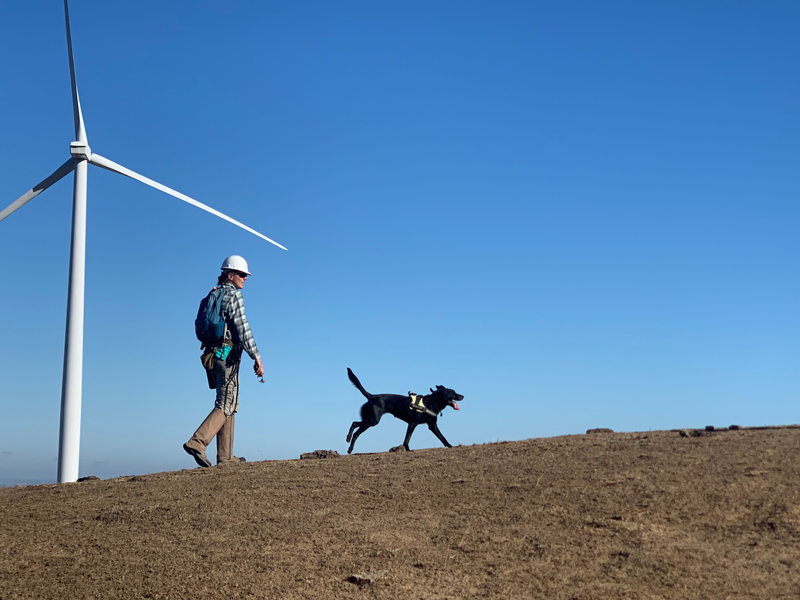
In the fight to remedy the causes of global climate change, the construction and operation of renewable energy sites is on the rise worldwide. Ecological detection canines have become a vital tool for scientists involved in the permitting and monitoring of wind and solar energy producing facilities. Properly trained wildlife detection dogs have proven to be of immense value for the discovery of bird and bat carcasses. Such mortality studies are required for renewable energy sites in an effort to determine the impact of these sites on local and migratory bird and bat species.
In multiple studies conducted at wind farm facilities throughout the California Altamonte, the skills of the ecological detection canine were put on display as they were able to be compared head-to-head with human-only surveys. The habitat throughout the area consists of rolling hills covered with grazed annual grassland. The turbines are situated on hilltops and ridgelines, with topographic variation between hill/ridge tops and intervening valleys. Generally, the ability of detection dogs to locate even small bits and pieces of bats and birds that qualified as detectable fatalities far outweighed those that human searchers could visually identify. These scavenged or degraded carcasses would not have been detected by human observers especially under the terrain and vegetative conditions present at these sites.
During a study at Vasco Winds of human-only search teams, 902 carcasses ranging in size and weight were placed onsite over the three-year monitoring period, including 547 small birds, 196 large birds, 15 extra-large birds, and 144 bats. Of those placed, 188 small birds, 158 large birds, 15 extra-large birds ad 86 bats were known to have been available for detection by searchers on their first search of a turbine. The proportions of those trail carcasses found by human-only searchers during the first search over all years combined were 34% of small birds, 68% of large birds, 83% of extra-large birds and only <6% of bats (Brown et al. 2013).
In a 2018 study conducted at the Golden Hills wind facility conducted by H.T. Harvey & Associates, of the 198 placed carcasses; six bats, five small birds, two medium birds, and one large bird were most likely removed before a detection-dog team had a chance to detect the carcass. Limited to first opportunities to detect placed carcasses, the overall searcher-efficiency estimates for the dog teams across Year 1 were 57% for bats, 48% for small birds, 65% for medium birds, and 76% for large birds. Given multiple opportunities to detect placed carcasses, the efficiency ratings increased to 68% for bats, 57% for small birds, 81% for medium birds, and 92% for large birds. The results of this first-year study clearly reiterated the high value of detection dogs for detecting bats, with an overall first-opportunity detection rate of 57% compared to the 12% rate for human searchers recorded during the APWRA Vasco Winds study. Differences for birds were not as evident, however especially for larger birds, which are much easier for humans to detect visually (Terrill et al. 2018).