Francis X. Villablanca; Christopher P. KofronCorresponding Author; Lauralea Oliver; Michael J. Walgren; Lisa E. Andreano;…
Pilot Study for the Use of Scent-Detection Dogs in Surveys for the Endangered Pima Pineapple Cactus
Prepared for: Arizona Department of Agriculture
Deborah Atkinson 1688 W. Adams Street Phoenix, AZ 85007
Prepared by: H. T. Harvey & Associates
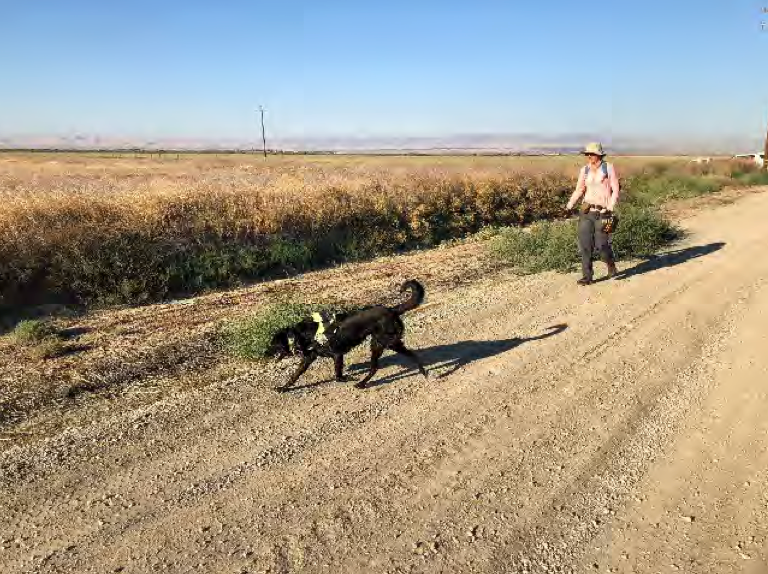
H. T. Harvey & Associates conducted a study to assess the efficacy of using ecological scent-detection dogs to survey for the cryptic Pima pineapple cactus (Coryphantha scheeri var. robustispina) (PPC) (Photo 1). To achieve the overall research goal, two scent-detection dogs were trained to recognize the scent of PPC and to discriminate the scent from that of sympatric cactus species. A trial phase was conducted with two detection dog teams, each consisting of one detection dog and one handler, to quantify the accuracy, sensitivity, and specificity in finding PPC.
PPC is listed as an endangered species by the U.S. Fish and Wildlife Service (USFWS) and as a highly safeguarded species by the State of Arizona. It grows on gently sloping alluvial fans, ridgetops, and basins of the Sonoran Desert scrub and semidesert grasslands of southern Arizona and northern Mexico (USFWS 1 993) . This cactus has proved difficult to detect during traditional transect surveys because it is sparsely distributed within its range and habitat and is small and often camouflaged by tall grasses or other vegetation.
Recommended protocol surveys for PPC are intensive and time consuming, requiring a three-tier approach comprising short-distance repeated transect surveys, local-area searches centered around PPC individuals detected during the survey, and focused ground-level surveys for seedlings, conducted in a 50-square-meter area around randomly sampled mature plants (Roller 1996). This intensive protocol was developed in response to empirical evidence gained during previous surveys. For example, Roller (1996) describes one PPC survey in which researchers conducted repeated transect surveys and found 1 00% as many plants on the second and third passes as on the first pass and did not find all the PPC in the plot until the sixth survey was complete.
Related Posts